
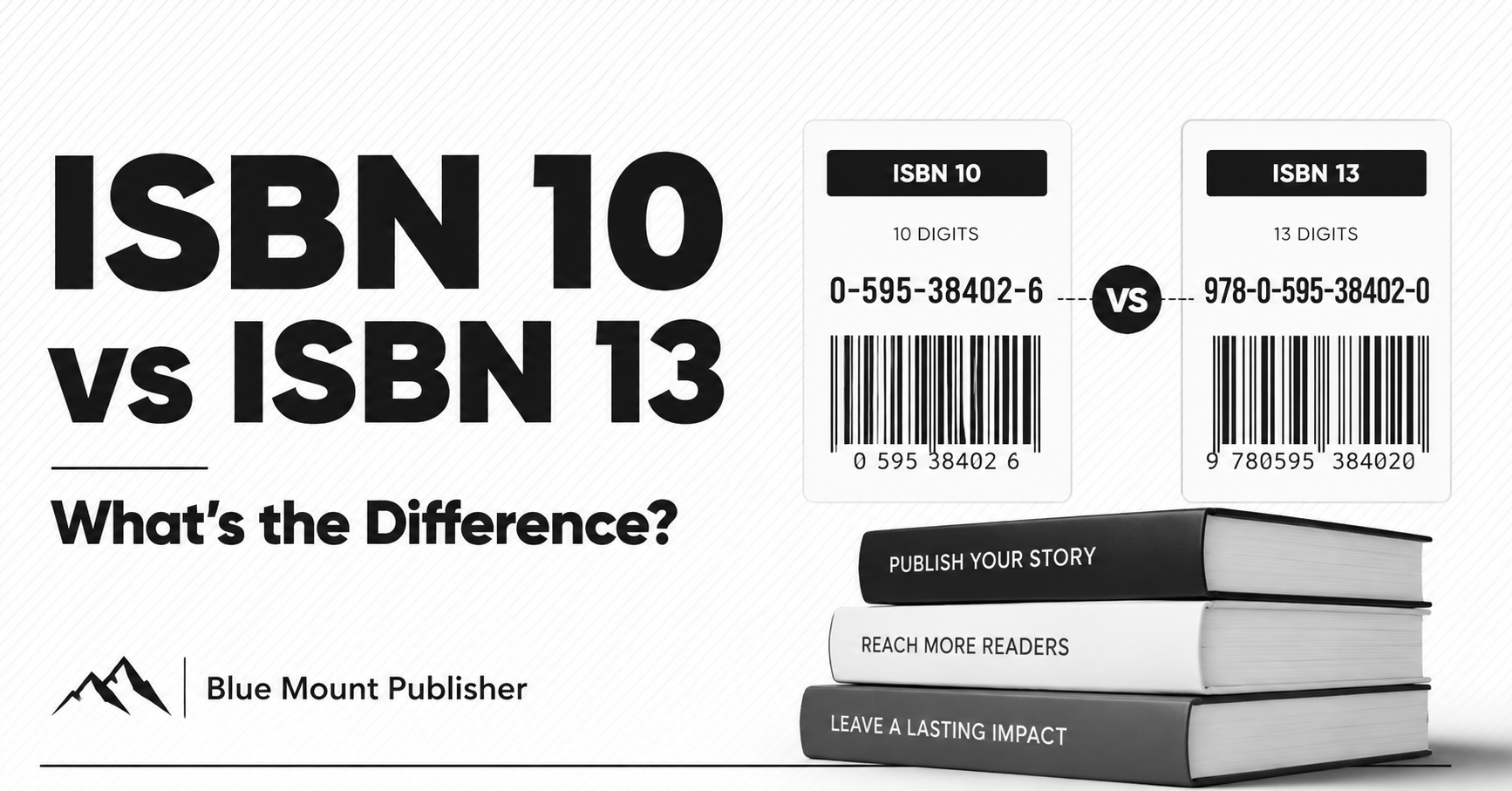
The difference between ISBN 10 and ISBN 13 is the number of digits, structure, barcode compatibility, and current publishing use. ISBN 10 has 10 digits and was used before the global shift to ISBN 13. ISBN 13 has 13 digits, starts with a 978 or 979 prefix, works with EAN-13 barcodes, and is the current book industry standard. Since January 1, 2007, ISBN 13 has been the required format for new ISBNs in the global publishing supply chain.
Blue Mount Publisher helps authors, self-publishers, and publishing businesses understand ISBN requirements so their books can be listed, distributed, tracked, and sold correctly across bookstores, libraries, wholesalers, and online retailers.
What Is an ISBN and Why Does It Matter?
An ISBN, or International Standard Book Number, is a unique book identifier. It helps publishers, booksellers, libraries, distributors, wholesalers, and online retailers identify a specific book title, edition, and format. The International ISBN Agency explains that an ISBN supports ordering, listing, sales records, and stock control in the book supply chain.
That matters because a paperback, hardcover, audiobook, and eBook version of the same title may each need a separate ISBN. The ISBN does not just point to a book title. It identifies a specific publishing product.
For authors and publishers, the ISBN connects the book to key metadata, such as:
- Title
- Author name
- Publisher name
- Format
- Edition
- Trim size
- Publication date
- Market availability
This metadata helps retailers and libraries display the right version of the book. It also helps buyers avoid ordering the wrong format.
What Is the Difference between ISBN 10 and ISBN 13?
The difference between ISBN 10 and ISBN 13 comes down to format, structure, and industry use.
ISBN 10 is the older 10-digit format. ISBN 13 is the current 13-digit format used for modern publishing, distribution, and barcode systems. The Library of Congress notes that ISBNs can consist of either ten or thirteen digits, while the global transition to ISBN 13 was completed for full adoption on January 1, 2007.
In simple terms:
ISBN 10 was common before 2007.
ISBN 13 is the current standard for books published today.
Both formats can identify books, but ISBN 13 works better with global retail systems because it aligns with the EAN-13 barcode structure used in international product distribution.
ISBN 10 Meaning
The ISBN 10 meaning is simple: it is a 10-digit International Standard Book Number used to identify books and book-like products before ISBN 13 became the global standard.
An ISBN 10 usually contains four parts:
- Registration group
This identifies the country, language area, or region. - Registrant or publisher element
This identifies the publisher or publishing imprint. - Publication element
This identifies the specific title, edition, or format. - Check digit
This validates the number. The check digit can be 0–9 or X, where X represents the value 10.
Example format:
ISBN: 0-306-40615-2
The final digit helps computer systems check whether the ISBN has been entered correctly.
ISBN 13 Meaning
The ISBN 13 meaning refers to the current 13-digit International Standard Book Number format. It is now used for newly assigned ISBNs in the publishing industry.
An ISBN 13 contains five parts:
- Prefix element
Usually 978 or 979. - Registration group
Identifies the country, language group, or region. - Registrant element
Identifies the publisher. - Publication element
Identifies the title, edition, and format. - Check digit
Validates the ISBN.
Since January 1, 2007, ISBNs have used the 13-digit format and include a GS1 prefix, usually 978 or 979.
Example format:
ISBN: 978-0-306-40615-7
The extra three digits at the beginning make ISBN 13 compatible with international barcode systems.
ISBN 10 vs ISBN 13 Comparison
Here is a clear ISBN 10 vs ISBN 13 comparison for authors and publishers.
| Feature | ISBN 10 | ISBN 13 |
|---|---|---|
| Number of digits | 10 digits | 13 digits |
| Current publishing standard | No | Yes |
| Common before 2007 | Yes | No |
| Used for new ISBN assignments today | No | Yes |
| Barcode compatibility | Limited without conversion | EAN-13 compatible |
| Prefix | No 978 or 979 prefix | Uses 978 or 979 |
| Check digit style | Can include X | Uses numeric check digit |
| Best for modern publishing | No | Yes |
This ISBN 10 vs ISBN 13 comparison shows why ISBN 13 is now the preferred format. It fits the needs of modern book retail, online listings, inventory systems, and international distribution.
What’s the Difference in ISBN Formats?
Many authors ask, “What’s the difference in ISBN formats?” The main difference is not just the number of digits. The formats also use different check digit calculations and different structures.
ISBN 10 was built for an older publishing environment. It worked well when book distribution was less connected to global retail barcode systems.
ISBN 13 was introduced to solve a larger issue. The publishing industry needed more available ISBN combinations and better compatibility with international product identification systems. The Library of Congress described the expansion from ISBN 10 to ISBN 13 as part of the move toward full ISBN 13 adoption by January 1, 2007.
So, the practical answer is this:
ISBN 10 identifies older books. ISBN 13 identifies books in the modern publishing and retail system.
Why Did ISBN Change from 10 to 13 Digits?
The change happened because the publishing industry needed a larger numbering system and better alignment with global product barcodes.
ISBN 13 added a prefix element, usually 978 or 979. This brought books into the EAN-13 barcode system, which is widely used for retail products. The International ISBN Agency notes that ISBN 13 includes a GS1 element, registration group, registrant, publication element, and check digit.
This change helped publishers and retailers manage books more efficiently across:
- Physical bookstores
- Online retailers
- Libraries
- Academic suppliers
- Wholesale distributors
- Inventory systems
- International sales channels
For authors working with Blue Mount Publisher, this matters because the right ISBN format helps prevent listing errors and distribution delays.
ISBN 10 Advantages
Even though ISBN 13 is the current standard, there are still a few ISBN 10 advantages in specific situations.
1. ISBN 10 appears on many older books
Books published before the ISBN 13 transition may still display an ISBN 10. Libraries, collectors, used bookstores, and academic databases may still use or recognize those numbers.
2. ISBN 10 can help identify older editions
If a reader searches for an older edition of a textbook, novel, or reference title, the ISBN 10 may lead to the exact version.
3. ISBN 10 is shorter
A 10-digit number is easier to read and type. This is useful when checking older records or printed book catalogs.
Still, these advantages are limited. ISBN 10 is useful for legacy identification, not for new publishing projects.
ISBN 13 Advantages
The ISBN 13 advantages are more important for today’s authors and publishers.
1. ISBN 13 is the current standard
New ISBNs are issued in 13-digit format. The U.S. ISBN Agency states that an ISBN is now a 13-digit number used to uniquely identify books and book-like products.
2. ISBN 13 works with modern barcodes
ISBN 13 aligns with EAN-13 barcode systems. This helps books move through retail, wholesale, and distribution channels.
3. ISBN 13 supports international sales
A book may be sold through online retailers, independent bookstores, libraries, academic sellers, and international distributors. ISBN 13 helps these systems recognize and process the book correctly.
4. ISBN 13 allows more numbering capacity
The 13-digit structure gives the publishing industry more available ISBNs, especially with 978 and 979 prefixes.
5. ISBN 13 improves metadata consistency
Clean metadata matters. A correct ISBN 13 helps connect a book’s title, format, author, publisher, edition, and retail listing.
For modern publishing, ISBN 13 is not just preferred. It is expected.
Can ISBN 10 Be Converted to ISBN 13?
Yes, many ISBN 10 numbers can be converted to ISBN 13 if they are connected to the 978 prefix. The Library of Congress provides an ISBN converter that can validate and convert 10-digit and 13-digit ISBNs.
However, not every ISBN 13 can be converted back to ISBN 10. ISBNs that begin with 979 generally exist only in 13-digit format and are not convertible to ISBN 10. The American Library Association notes that 979 ISBNs are not convertible to a 10-digit format.
That point matters for authors. A new ISBN assigned today may not have an ISBN 10 version at all.
Does a Book Need Both ISBN 10 and ISBN 13?
For a newly published book, no. A book needs the current ISBN 13 format.
Some older books may show both ISBN 10 and ISBN 13 in databases or catalog records. The Library of Congress notes that during the 2005–2007 transition period, some bibliographic agencies included both a 13-digit number and a 10-digit number for the same item.
Today, the focus should be ISBN 13. Authors do not need to request both formats for a new book.
Is ISBN 13 Better Than ISBN 10?
For current publishing, yes. ISBN 13 is better because it is the active global standard.
ISBN 10 still has value for older books, used book catalogs, library records, and historical editions. But for a new book, ISBN 13 is the right choice.
Blue Mount Publisher recommends that authors focus on ISBN 13 because it supports:
- Bookstore listings
- Library cataloging
- Print distribution
- eBook distribution
- Wholesale ordering
- Metadata management
- Barcode creation
- Long-term discoverability
This helps reduce publishing errors and makes the book easier to identify across sales channels.
How ISBNs Affect Book Publishing and Distribution
An ISBN does more than sit on the copyright page. It connects the book to the commercial book supply chain.
The International ISBN Agency describes the ISBN as a product identifier used by publishers, booksellers, libraries, internet retailers, and other supply chain participants for ordering, listing, sales records, and stock control.
That means an ISBN affects how a book appears in:
- Retail databases
- Library systems
- Distributor catalogs
- Bookstore ordering platforms
- Online product pages
- Sales reporting systems
A book with missing or incorrect ISBN data may face listing problems. The wrong ISBN can also cause confusion between formats. For example, a hardcover ISBN should not be used for the paperback version.
Each format needs clear identification. That is why professional publishing support matters.
ISBN 10 vs ISBN 13 for Self-Publishing Authors
Self-publishing authors often see both ISBN 10 and ISBN 13 online and wonder which one they need.
For a new self-published book, the answer is ISBN 13.
Authors may see ISBN 10 on older books listed on Amazon, library catalogs, or used book sites. That does not mean ISBN 10 should be used for a new title.
A self-published author should use ISBN 13 for:
- Paperback editions
- Hardcover editions
- eBook editions when required
- Audiobook editions when applicable
- Revised editions
- New formats
A separate ISBN may be needed when the book format changes. For example, the paperback and hardcover should not share one ISBN. Each version is a separate product.
Common ISBN Mistakes Authors Should Avoid
ISBN mistakes can create distribution issues. Blue Mount Publisher often sees authors confused by ISBN format, ownership, and metadata setup.
Here are common mistakes to avoid:
Using the same ISBN for every format
A paperback, hardcover, and audiobook are different products. Each should have its own ISBN when required by the sales channel or distribution plan.
Assuming ISBN 10 is still enough
ISBN 10 may appear in older records, but ISBN 13 is the correct format for new publishing.
Entering ISBN digits incorrectly
One wrong digit can point systems to the wrong book or cause validation failure.
Ignoring publisher ownership
The ISBN identifies the publisher of record. Authors should understand whether they own the ISBN or whether a platform or service provider owns it.
Changing book details without updating metadata
Metadata should match the final book details. Title, subtitle, author name, format, and edition details should be consistent.
These small details can affect discoverability and sales.
How Blue Mount Publisher Helps with ISBN Setup?
Blue Mount Publisher provides book publishing services that help authors prepare their books for professional release. ISBN guidance is part of that process.
The team helps authors understand:
- Whether their book needs an ISBN
- Which format needs a separate ISBN
- How ISBN 13 works
- How ISBN metadata supports distribution
- How to avoid ISBN and barcode errors
- How publishing details affect retail listings
This helps authors move through publishing with fewer technical problems.
ISBN setup may seem simple, but it connects to book metadata, distribution, cataloging, and long-term discoverability. Getting it right early saves time later.
Quick Answer: ISBN 10 vs ISBN 13
The best way to understand ISBN 10 vs ISBN 13 is this:
ISBN 10 is the older 10-digit format used before the publishing industry shifted to ISBN 13. ISBN 13 is the current 13-digit standard used for new books, retail barcodes, and global distribution.
For older books, ISBN 10 may still appear in records. For new books, ISBN 13 is the format authors and publishers should use.
Conclusion
The difference between ISBN 10 and ISBN 13 is important for authors, publishers, bookstores, libraries, and distributors. ISBN 10 belongs mostly to older publishing records. ISBN 13 is the current standard for modern books and global distribution.
For authors preparing a new book, ISBN 13 is the right format. It works with EAN-13 barcodes, supports accurate metadata, and helps retailers and libraries identify the correct book edition and format.
Blue Mount Publisher helps authors handle these details with care, so the book is prepared for professional publishing, clean distribution, and better discoverability.
FAQs About ISBN 10 vs ISBN 13
1. What is the main difference between ISBN 10 and ISBN 13?
The main difference is the number of digits and current use. ISBN 10 has 10 digits and was used before 2007. ISBN 13 has 13 digits and is the current standard for new books.
2. Is ISBN 10 still valid?
Yes, ISBN 10 can still be valid for older books. However, new books use ISBN 13.
3. Can an ISBN 10 be converted to ISBN 13?
Many ISBN 10 numbers can be converted to ISBN 13, especially when they use the 978 prefix. ISBN 13 numbers that begin with 979 usually cannot be converted to ISBN 10.
4. Do authors need ISBN 10 or ISBN 13?
Authors publishing a new book need ISBN 13. ISBN 10 is mainly useful for older books and legacy records.
5. Why does ISBN 13 start with 978 or 979?
ISBN 13 uses a GS1 prefix. Most ISBN 13 numbers begin with 978 or 979, which helps align ISBNs with global EAN-13 barcode systems.
6. Is ISBN 13 better for self-publishing?
Yes. ISBN 13 is better for self-publishing because it is the current format used by retailers, distributors, libraries, and publishing platforms.
7. Does every book format need a different ISBN?
In most professional publishing workflows, each format needs its own ISBN. A paperback, hardcover, eBook, and audiobook are separate products.
8. Is an ISBN the same as a barcode?
No. An ISBN is a book identifier. A barcode is the scannable symbol that can represent the ISBN for retail and inventory systems. ISBN.org states that an ISBN is a number, not a barcode.
9. Can a book have both ISBN 10 and ISBN 13?
Yes, older books and catalog records may show both. During the ISBN transition period, some agencies included both formats for the same item.
10. Where should authors get an ISBN?
Authors should get an ISBN from the official ISBN agency in their country. In the United States, Bowker is the official U.S. ISBN Agency.