
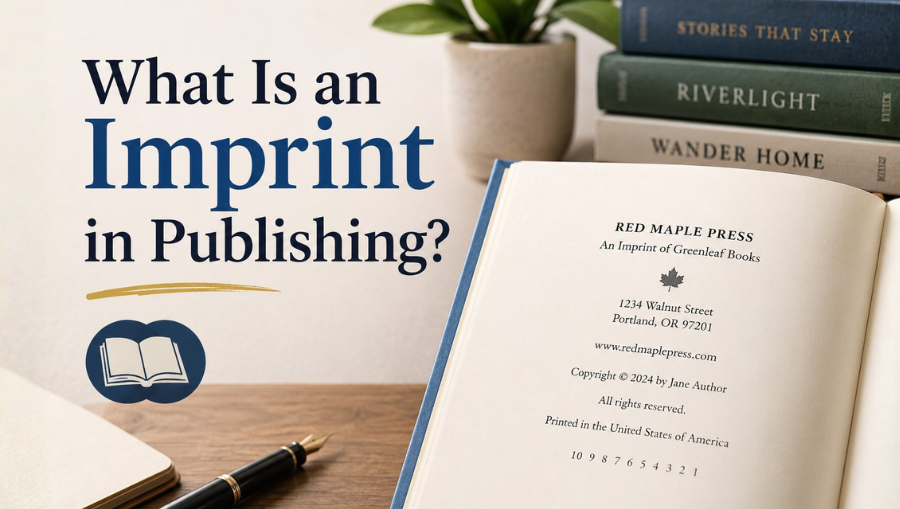
An imprint in publishing is a kind of map that publishers use to shape the identity of the book. It helps authors find the right home, and helps readers sort the flood.
This article is about the publishing imprint’s meaning at a practical level and at a cultural one. It matters now because writers are no longer choosing between only two roads. They may seek a major house, a small press, a hybrid service, or a self-made label. To make a smart decision, they need to understand how publishing imprints work, what an imprint does, and where the line sits in the old debate of imprint vs publisher. The subject sounds technical, almost dry.
What is an Imprint?
An imprint is a public-facing identity. It can tell readers whether they are holding literary fiction, romance, science fiction, business advice, children’s books, or serious history. It can also tell booksellers and reviewers how to place the title in their minds.
The imprint of a book becomes shorthand for a set of expectations. Some imprints are known for risk and originality. Some are known for prestige. Some are known for dependable genre work. Some promise broad appeal and airport readability. None of these is an insult. They are market positions, and they are also statements of taste.
An imprint may have its own editorial mission. It may focus on a narrow field or a wide category.
A practical guide for entrepreneurs may do best under a business-focused label with strong ties to that market. The manuscript is the same object. The frame around it changes how it is seen.
That is why an imprint is not just a logo. It is an editorial address. It tells the world where the book lives inside the larger city of publishing.
What is an Imprint in Publishing?
The simplest answer is this: an imprint in publishing is a trade name used by a publishing company to release books under a specific identity. It is not always a separate business.
But each restaurant has its own menu, design, and regular crowd. One serves quiet French food under low light. Another sells coffee and pastries all day. Another is loud, modern, and quick. The guest may not care who owns the building. The guest cares what kind of meal is being served. That is often how an imprint works in publishing.
The publishing imprint’s meaning becomes clearer when one looks at the structure of a large publishing group. The parent company may handle printing deals, legal matters, sales teams, rights, and distribution. The imprint may handle editorial vision, list building, and brand identity.
This is why the word “imprint” can feel oddly physical. Historically, it referred to a printed indication of who produced the book. Over time, it came to mean the branded identity under which the book appears. The old mechanical world grew into a modern cultural one. A reader may never say, “I trust this imprint,” but many readers act as if they do. They follow patterns. They notice cover styles. They remember the kind of books that carry a certain name. In that sense, the imprint is part business tool, part social signal.
Why Do Publishing Companies Use Imprints?
Publishing companies use imprints because one name cannot easily do every job. Booksellers would lose useful cues. Authors might feel miscast. Imprints solve that problem by letting one company become many recognizable voices.
There is also a harder truth beneath the elegance. Publishing is not only an art; it is a sorting system. The market is crowded. Attention is scarce. Every title needs a story about where it belongs. An imprint helps create that story before a reader opens the first page.
Brand Specialization in Imprint Publishing
Brand specialization is one of the clearest reasons imprints exist. A publishing house can use separate names to serve separate reading communities. This is not only about genre. It is about tone, design, editorial taste, price point, and cultural posture.
A literary imprint may favor careful prose, ambitious structure, and books likely to earn serious reviews. A commercial fiction imprint may look for speed, hook, and broad reach. A children’s imprint may build trust with parents, teachers, and librarians. A faith-based imprint may signal values as much as subject matter. In each case, the imprint in publishing becomes a promise: readers return because they think they know the house style.
For the publisher, brand specialization also reduces confusion. It is easier to market a list when the books speak to one another. Covers can echo one another without feeling repetitive. Publicists can build strong media lists. Sales teams can speak more clearly to retailers. Editors can shape a list with purpose rather than scattershot ambition.
There is a lesson here for writers, too. Many emerging authors send work to “big publishers” as if size alone were the relevant fact. Often, the better question is not which publisher, but which imprint. That is where the editorial fit usually becomes visible.
Marketing Strategy and the Publishing Imprint Meaning
Marketing strategy sits at the heart of the modern imprint system. A book is sold through story, but it is also sold through category. The publishing imprint’s meaning becomes especially practical when a title needs a market position. An imprint can help create that position in a clean and immediate way.
If a house launches a new line for suspense, wellness, or diverse romance, it is often because the company sees a growth lane and wants a sharper spear. The imprint can develop its own mailing lists, visual style, social voice, and trade reputation. It can speak directly to a niche while still drawing from the larger company’s resources. This is one reason imprints survive even when mergers flatten so much else. They are agile. They let old institutions seem more specific than they are.
Marketing strategy also explains why some imprints feel more visible than others. An imprint with a strong identity becomes legible in the culture. Readers mention it in book clubs. Agents pitch toward it. Reviewers understand its lane. The name begins to function almost like a genre marker. That is not magic. It is repetition and coherence over time.
Still, the strategy carries risk. A very narrow imprint can become boxed in. A brand built too tightly around one trend may look tired when the market shifts. An imprint can also become a mask that hides how centralized the real power remains. A reader may imagine a lively republic of independent voices where there is, in fact, one corporate roof. Yet even then, the imprint matters because branding shapes real outcomes.
Author Branding, the Imprint of a Book, and Reader Trust
Every author represents their own brand, whether they like it or not. Likewise, every reader forms an impression after seeing the brand, and hence, the buying choice is affected accordingly.
For a debut writer, the right imprint can lend context and trust. It tells agents, booksellers, and early readers that experienced editors saw value in the manuscript and placed it in a recognizable home. A literary novelist writing a thriller under a fresh banner may avoid confusing loyal readers while reaching new ones.
This is not only about prestige. It is also about alignment. A strong romance writer does not always need a “serious” literary label; such a move could even muddy the audience. A business author does not gain by being dressed in the codes of avant-garde fiction. The best author branding is not status seeking. It is accurate framing.
That framing can influence everything from jacket design to launch plan. Some imprints are better at nurturing long careers. Some are better at fast commercial launches. Some editors are known for deep line edits. Some imprints are strong in foreign rights. Others have better ties to certain media circles. When authors think about the imprint vs publisher question, this is often the hidden answer: the publisher may own the machinery, but the imprint often shapes the lived experience of the book.
Genre Categorization and How Publishing Imprints Work
Genre categorization is one of the oldest and most practical uses of imprints. It allows publishers to organize lists with clarity.
There are numerous categories and sub-categories. The main categories are fiction, non-fiction, academic, and business, with sub-categories like romance, mystery, biography, children’s books, and young adult fiction. The imprint helps keep those lines clear.
This is how publishing imprints work on the ground. Editors acquire titles that suit the imprint’s mission. Designers build a visual language that readers can learn to recognize. Sales teams pitch the books to the right buyers. Publicists aim at the right media. The imprint becomes a frame that holds the work in place as it travels through the market.
Genre categorization can also protect a book from the wrong expectations. A dark, strange novel published under a broad commercial label might reach many people who do not want it. The same novel under a more precise imprint may sell fewer copies at first but build a steadier, more loyal audience. In publishing, a good fit can matter more than a loud launch.
There is, however, a danger when categorization becomes too rigid. Some of the best books trouble the shelves. They cross memoir and criticism, horror and satire, history and narrative art. A rigid imprint system can make those books harder to place. The smartest publishers leave room for books that resist easy filing. They understand that category is a guide, not a prison.
Publishing Imprint Examples and Examples of Famous Publishing Imprints
The easiest way to understand publishing imprint examples is to look at names readers often recognize, even if they do not always know why. Knopf has long carried an air of literary distinction. Riverhead is often linked with stylish, contemporary fiction and ambitious nonfiction. Vintage is familiar to many readers through paperback editions and backlist strength. Tor is strongly associated with science fiction and fantasy. Del Rey is also known in speculative fiction circles. Harlequin is tied in the public mind to romance. Penguin Classics signals canonical works and enduring texts.
Over time, the imprint becomes a kind of editorial signature. It is never perfect. Great books appear in unexpected places. Weak books slip through strong brands. But the signal remains useful.
For writers, these examples are more than trivia. Imprint offers clues about the overall editorial system. Any writer who is learning about submitting their work, learning about a query letter, and navigating the publishing industry is actually learning about the imprint in publishing. Some basic queries could be:
- What kind of book are they publishing?
- What does the book cover look like?
- What is the overall tone of the catalog copy?
- Which Reviewers are likely to pay attention?
Difference Between Publisher, Imprint, and Self-Publishing Company
A publisher is the larger business entity that manages the main publishing operation. It may own the contracts, distribution systems, accounting, legal support, and broad infrastructure. An imprint is a brand or division under that publisher. It may have a distinct editorial mission or target audience, but it is often not a separate company in a legal or operational sense.
A self-publishing company is different again. In many cases, it is a service provider that helps authors produce and release their books, often for a fee. It may offer editing, design, formatting, printing, marketing help, or distribution assistance. Sometimes it is transparent and useful. Sometimes it is dressed up in the language of traditional publishing while asking the author to bear most of the cost and risk. That is where caution matters.
The imprint vs publisher distinction is easy to remember once the layers are clear. The publisher is the parent structure. The imprint is the public-facing label used for a certain kind of list. The self-publishing company is usually a separate service model in which the author retains more control, but also more responsibility.
Some self-published authors create their own imprint name. That does not magically turn them into a traditional publishing house, but it can be smart. It gives the book a cleaner identity, helps organize future titles, and can make the publishing line look more professional. Still, the functions remain different. Owning an imprint name is not the same as owning national distribution, bookstore relationships, a rights team, and an editorial staff. The distinction should not be romanticized, but neither should it be mocked. Many strong author-led businesses begin with a modest imprint and grow from there.
How Publishing Imprints Work?
At the practical level, how publishing imprints work depends on the size and culture of the company behind them. In a large house, an imprint may have its own editorial director, acquiring editors, assistants, and a list strategy. In a smaller operation, the imprint may mainly shape branding and catalog identity while sharing staff with other divisions.
A typical path looks like this: an editor acquires a manuscript for a specific imprint because the project fits that list’s editorial mission. Once accepted, the book moves through editing, design, production, sales planning, publicity, and distribution. Throughout that process, the imprint guides major choices. It affects jacket language, comparable titles, launch positioning, media targets, and bookstore placement. It may also affect expectations about print run, advance size, and audience reach.
This is one reason a book’s home can matter as much as its raw quality. The same manuscript can be edited differently, packaged differently, and pitched differently depending on the imprint. An editor with deep knowledge of a niche can make sharper choices than a generalist with a wider but thinner remit. A seasoned imprint knows its readers. It knows which cover clichés to avoid and which cues actually work. It knows whether the book needs a festival tour, a podcast campaign, a review push, or patient word of mouth.
At its best, the imprint is an interpretive frame. It helps the industry understand what this book is trying to do. At its worst, it is a shallow label added after the fact. The difference lies in whether the imprint has a living editorial identity or only a sales function. Good publishers know that readers can feel the difference, even if they cannot always name it.
How Imprints Help Authors?
Imprints help authors in ways both visible and hidden. The visible help is easy to name: sharper branding, clearer market placement, stronger category knowledge, and more direct access to the right audience. The hidden help is often more important: editorial fit, internal advocacy, and career shaping.
An imprint with a defined mission knows what success looks like for a given kind of book. It will not judge a quiet essay collection by the same standards as a celebrity memoir. It will not demand that every novel behave like a thriller. That sounds obvious, yet many authors discover too late that a mismatched home can distort a book. The wrong expectations lead to the wrong edits, the wrong cover, and the wrong launch.
Imprints also help authors by building continuity. Readers who loved one title from a certain imprint may be more willing to try another. Booksellers may pay closer attention to new releases from a trusted line. Reviewers may open those galleys first. None of this guarantees success, but it lowers friction. It means the book arrives in a context that is already legible.
For debut authors, this can be a decisive advantage. A new writer does not yet have a brand, a fan base, or a proven sales record. The imprint lends a first layer of meaning. It says: ” This work belongs here. That phrase can do more than it seems. In publishing, belonging is often the first form of visibility.
There is also the question of long-term growth. Good imprints do not only publish books; they build lists. A list is not a pile of titles. It is a pattern of judgment over time. Authors who enter a strong list may benefit from the halo of neighboring books, thoughtful positioning, and editors who are invested in building a durable identity rather than chasing a single season’s noise.
How to Start Your Own Publishing Imprint?
Many writers reach a point where they ask a modern question with old roots: if publishers can create imprints to shape identity, why can’t authors do the same? The answer is that they can, and many do. But they should do it with open eyes.
To start a publishing imprint, an author usually begins by choosing a name that is distinct, memorable, and legally usable. The name should not mimic a famous publishing house or invite confusion. The next step is to check domain availability, business registration rules, and trademark concerns in the relevant market. A simple imprint can begin as a brand name used on the copyright page and cover materials, but authors who plan to grow may also form a business entity for cleaner accounting and rights management.
After that comes the practical layer, the author needs ISBNs where required, cover design, interior formatting, editing, metadata, distribution channels, and a clear plan for print and digital release. The imprint should have a visual identity, however modest: logo, type choices, website, and consistent credits. None of this needs to be grand. It does need to be coherent.
The danger is that some writers treat an imprint as decoration, as if a name alone creates authority. It does not. Readers may not care whether the imprint looks official if the book is poorly edited, sloppily designed, or hard to buy. The opposite is also true. A small author-run imprint can earn real trust if it produces books with care and consistency.
Authors should also decide what kind of imprint they want. Is it only for one writer’s books? Is it a family label for a small niche? Is it meant to grow into a micro-press that publishes other authors? Each path carries a different workload and legal burden. Many writers are happiest keeping the imprint simple: a professional publishing identity for their own catalog.
A smart author-run imprint can offer several advantages. It gives the writer a cleaner brand, helps separate books from generic self-publishing clutter, and creates room for future expansion. It can also look more professional to reviewers, podcasters, librarians, and event organizers. But it also means the author becomes the publisher in the fullest sense. The freedom is real. So is the labor.
Is an Imprint the Same as a Publisher?
No. An imprint is not the same as a publisher, though the two are often confused because they appear close together on a book and share many public functions.
A publisher is the overarching company responsible for the business of publishing. That can include editorial departments, contracts, finance, rights, production, distribution, and sales infrastructure. An imprint is usually a branded division or label within that larger company, created to focus on a certain type of book or audience.
Why does the confusion persist? Partly because readers encounter the imprint more often than the parent company. The imprint is what appears on the spine, in catalogs, in conversations about taste, and in the shorthand of bookselling. A reader may say, “This feels like a Knopf book,” not because Knopf is the only corporate layer involved, but because the imprint identity is what the reader can feel.
For authors, the distinction matters because the imprint often shapes the editorial experience, while the publisher controls the wider business framework. Both matter. One gives the book its immediate cultural frame. The other supplies the machinery that moves the book through the market.
When Should Authors Use an Imprint?
Authors should think about using an imprint when they want a clearer publishing identity than their own name alone can provide. This is especially useful for writers who plan to publish multiple books, work across a series, or build a long-term catalog.
A self-published novelist releasing one book may not need an elaborate imprint. But a writer publishing several romance novels, children’s books, or business guides may benefit from a consistent imprint name. It helps create order. It can also signal seriousness to retailers and readers. The books begin to look like parts of a body of work, not isolated uploads.
An imprint can also help authors who write in more than one genre. A children’s author who also writes dark crime fiction may prefer separate public identities. A nonfiction expert who wants to publish poetry may do the same. In such cases, an imprint can serve as a boundary line. It does not solve every branding problem, but it can reduce confusion.
Authors should also consider an imprint when they want more control over rights, packaging, and long-term positioning. In the traditional world, this control is limited by the publisher’s systems and contract terms. In the self-directed world, it expands sharply. That freedom can be worth a great deal, but only when matched by strong editorial standards and realistic marketing plans.
The best time to create an imprint is not when a writer wants to sound bigger. It is when the writer is ready to think like a publisher.
The Quiet Power of the Small Name
What makes the idea of the imprint so durable is that it lives at the meeting point of art and commerce, where publishing has always been a little uneasy. Writers want their work judged as literature, or at least as honest craft. Publishers must judge it also as a product, category, timing, and fit. The imprint does not erase that tension. It gives it a face.
There is something almost novelistic about this arrangement. A large corporation fragments itself into smaller identities so that books may travel with more intimacy. A giant speaks in whispers because whispers sound more trustworthy. Yet the arrangement is not only cynical. Readers do need guides. Editors do build real cultures. Writers do benefit from being published in places where their work is understood rather than merely processed.
That may be the most useful way to think about an imprint in publishing. It is neither a trivial label nor a sacred seal. It is a frame. And frames matter because they change what the eye can see.
In the end, the little name on the spine is doing more work than it seems. It tells a reader where the book has come from, what shelf it hopes to live on, and what kind of conversation it wants to enter. For authors trying to navigate a crowded field, that knowledge is not minor trade jargon. It is a practical tool. And for those who want guidance as they shape their own path, Blue Mount Publishers offers book writing and publishing services for authors with reasonable and affordable pricing. The wiser view, though, is not to treat any service as a shortcut. A good imprint, whether built by a major house or an independent author, still begins the old-fashioned way: with clear purpose, careful craft, and a book that knows what it is.
FAQs About Imprint in Publishing
Is an imprint different from a publisher?
Yes. An imprint is different from a publisher, though the two are connected. The publisher is the larger company that handles the main business side of publishing, such as contracts, production, distribution, and rights. An imprint is usually a branded label within that larger company. It is often built around a certain type of book, audience, or editorial style. So when people compare imprint vs publisher, the easiest way to think about it is this: the publisher owns the structure, while the imprint shapes the public identity of the book.
Can self-published authors create an imprint?
Yes, self-published authors can create an imprint, and many do. A self-made imprint can give books a more polished identity, especially if the author plans to publish more than one title. It can help with branding, series planning, and long-term catalog building. Still, an imprint name alone does not replace professional editing, strong design, or good distribution. The most effective author-run imprints are not just labels on a copyright page. They are part of a careful publishing plan, supported by quality work and consistent presentation.
Why do big publishers have multiple imprints?
Big publishers have multiple imprints because one broad company name cannot clearly serve every audience or genre. Different books need different editorial teams, marketing strategies, and brand signals. A romance novel, a literary essay collection, and a science fiction epic do not reach readers in the same way. By using several imprints, a publisher can build stronger specialization and a clearer identity. This also helps authors find a better fit for their work. In practical terms, multiple imprints allow one company to act with more precision in a crowded market.
Does an imprint affect book sales?
An imprint can affect book sales, though it does not guarantee them. A respected or well-matched imprint can help a book reach the right readers faster because booksellers, reviewers, librarians, and loyal readers often recognize the signal it sends. The imprint of a book may shape expectations about quality, genre, tone, or audience. That can improve discovery and trust. Still, sales depend on many factors, including the book itself, the cover, timing, publicity, price, and word of mouth. The imprint is not the whole story, but it can be an important part of it.